Conjugarea verbului a tempt
Traducere: a ispiti, a ademeni, a încerca, a momi, a tenta, a seduce a aţâţa, a invitaConjugare [tempt]
Conjugarea este crearea unor forme derivate ale unui verb din părțile sale principale de inflexiune (alterarea formei în conformitate cu regulile gramaticale). De exemplu, verbul „break“ poate fi conjugat pentru a forma cuvintele pauză, pauze, rupt, spart și de rupere.
Conjugarea Termenul se aplică doar inflexiei verbelor, și nu din alte părți ale vorbire (inflexiune substantivelor și adjectivelor este cunoscut sub numele de declinare). De asemenea, este adesea limitată la ceea ce denotă formarea de forme finite ale unui verb - acestea pot fi denumite forme conjugate, față de non-forme finite, cum ar fi infinitiv sau gerunziului, care nu tind să fie marcate pentru majoritatea categorii gramaticale.
conjugarea este, de asemenea, numele tradițional pentru un grup de verbe care prezintă un model de conjugare similară într-o anumită limbă (o clasă de verb). Un verb care nu urmează toate modelele de conjugare standard ale limbii este declarat a fi un neregulate verb .
Condiţional
(Conditional)
[tempt]
Causality (denumit în continuare cauzării sau cauză și efect) este influența prin care un eveniment, proces, stare sau obiect (o cauza) contribuie la producerea unui alt eveniment, proces, stare sau obiect (un efect), în cazul în care cauza este parțial responsabil pentru efectul, iar efectul este parțial dependentă de cauza. În general, un proces are mai multe cauze, care sunt, de asemenea, menționate ca fiind factori cauzali pentru ea, și toate se află în trecutul său. Un efect poate fi la rândul său, o cauză a sau factor cauzal, multe alte efecte, care se situează toate în viitorul său.
condițional (cond abreviat) este o stare de spirit gramatical folosit în propoziții condiționale pentru a exprima o propunere a cărei valabilitate este dependentă de o anumită condiție, eventual contrafactuală.
engleză nu are un inflective (morfologic) condițional, cu excepția cazului în la fel de mult ca și verbele modale ar putea, s-ar putea, ar trebui și ar putea fi considerată în anumite contexte ca forme condiționate poate, poate, trebuie și vor respectiv. Ceea ce se numește condițional limba engleză (sau doar condițional) este format perifrastic folosind verbul modal ar fi, în combinație cu infinitiv goale a următorului verbului. (Ocazional, ar trebui să se folosește în loc de face cu un subiect prima persoană -.. A se vedea și va va fi de asemenea verbele modale menționate mai sus ar putea, s-ar putea și ar trebui să poate înlocui ar fi, în scopul de a-și exprima modalitatea adecvată, în plus față de condiționalitatea)
Imperfect
(Conditional present)
Condițional prezent progresivă
(Conditional present progressive)
Perfectă condiționată
(Conditional perfect)
Subjunktiv
(Subjunktiv)
[tempt]
subjunctive este o stare de spirit gramatical, o caracteristică a vorbirii care indică atitudinea vorbitorului față de ea. Formele subjunctive de verbe sunt de obicei folosite pentru a exprima diferite stări de irealitate, cum ar fi: dorință, emoție, posibilitate, hotărâre, aviz, obligație, sau acțiune care încă nu a avut loc; situațiile particulare în care acestea sunt utilizate variază de la o limbă la alta. SUBJUNCTIVUL este una dintre stările irrealis, care se referă la ceea ce nu este neapărat adevărat. Acesta este adesea în contrast cu indicativul, o stare de spirit REALIS care este folosit în principal pentru a indica faptul că ceva este o declarație de fapt.
Subjunctives apar cel mai frecvent, deși nu exclusiv, în clauzele subordonate, mai ales că-clauze. Exemple de SUBJUNCTIVUL în limba engleză se găsesc în propozițiile „Vă sugerez să fii atent“ și „Este important ca ea sta de partea ta.“
Starea de spirit subjonctiv în limba engleză este un tip de clauză utilizată în unele contexte care descriu posibilitățile non-reale, de exemplu, „Este important să fii aici“ și „Este esențial ca el ajunge mai devreme.“ În limba engleză, SUBJUNCTIVUL este sintactică, mai degrabă decât flexionar, deoarece nu există nici o formă verb specific subjonctiv. Mai degrabă, clauzele recruta forma modul conjunctiv goale a verbului, care este, de asemenea, utilizat într-o varietate de alte construcții.
Subjonctiv Prezent
(Present subjunctive)
Subjonctiv Trecut
(Past subjunctive)
Imperativ
(Imperativ)
[tempt]
modul imperativ este o stare de spirit gramatical care formează o comandă sau cerere.
Un exemplu de un verb folosit în starea de spirit imperativ este expresia engleză „Du-te.“ Astfel de imperative implică oa doua persoană subiect (tu), dar unele alte limbi au de asemenea imperative de prima și a treia persoană, cu sensul de „a lăsa (a face ceva)“ sau „lasa sa (faca ceva)“ (formularele pot în mod alternativ să fie numit cohortative și jussive).
Participiu
(Participle)
[tempt]
În lingvistică, a participle (ptcp) este o formă de nonfinite verb care cuprinde perfective sau aspect continuative în numeroase timpuri. Un participle, de asemenea, poate funcționa ca un adjectiv sau un adverb. De exemplu, în „cartof fiert“, fiartă este participiul trecut a fierbe verbul, modificarea adjectival cartofului substantiv; în "fugit ne zdrențăroși," calic este participiul trecut al verbului LAR, calificare adverbially RAN verbul.
Utilizați butonul "Selecţie aleatorie"
| Începeți cu studiul de verbe neregulate: |
| Selecţie aleatorie = >> |
Verbe neregulate engleză ușor și rapid!
Cauti un verb neregulat specific?
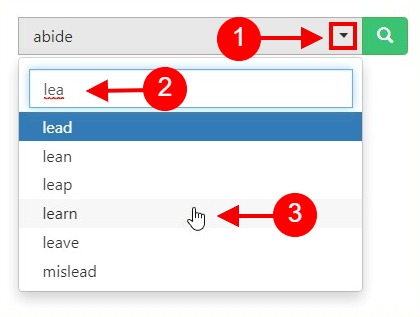
Utilizați căutarea (filtru)